In January 2016, a geologist walked through Barrio Los Ángeles documenting 32 hand-dug wells. Most had less than 30 centimeters of water. Many were contaminated. Families were bathing in the river. Children were getting sick.
Ten years later, those same families have clean drinking water flowing from their taps. This is the documented story of how that happened.
The Crisis: January 2016
Barrio Los Ángeles sits on the north bank of the Nosara River. For generations, the community had no public water service — not from ASADA Nosara, not from ASADA Santa Marta, not from AyA. Every family dug their own well.
On January 31, 2016, consulting geologist José Vargas Gutiérrez (registration CGCR-180) conducted a formal census of wells in the community. What he found was alarming.
From the Geological Report — February 2016
"The sanitary condition of practically all the wells is alarming. Due to the small size of the properties, the distance to septic tanks or their drainage does not meet minimum recommendations — most of these structures are located between 5 and 20 meters from the well openings."
— José Vargas Gutiérrez, Consulting Geologist (CGCR-180)
The report documented over 30 wells with water tables between 4 and 30 centimeters. Several wells had been abandoned after owners confirmed contamination — bad smell, bad taste, stomach illnesses. Residents shared water between family members when one well ran dry, carried water in buckets and bottles, and bathed in the river.
The situation had multiple causes: the CNE's construction of a flood control dike along the Nosara River (built by JCB Construcciones S.A.) had deepened the riverbed and waterproofed the banks, lowering the water table. An earthquake had raised the coastal land. Years of El Niño drought had depleted what remained.
The Committee
The geological study wasn't commissioned by the government. It was requested by a community committee organized to solve the problem themselves.
The committee's approach was practical: join ASADA Santa Marta, which had few users and operational capacity, and fund the infrastructure needed to extend service to Barrio Los Ángeles. Neighbors volunteered to donate land and contribute financially toward drilling a deep well that would become ASADA property.
Among those on the committee was Marion Peri, who would later develop the Mar Azul and Nosara Hills projects in the hills above the community.
The Well: March 2021
On March 8, 2021, Perforaciones Jiménez y Delgado issued invoice #148 for the drilling of a deep well at Santa Marta. The well would be registered as GA-334 with the National Groundwater Registry.
The well was drilled at an elevation of 35 meters above sea level. Testing confirmed a yield of 3.23 liters per second — enough to supply hundreds of families.
Official Approval: June 2025
On June 25, 2025, Oscar Ampié Bermúdez of AyA's Rural Aqueduct Management Unit (UEN Gestión de Acueductos Rurales) issued Report No. GSD-UEN-GAR-2025-02417. The technical study for connecting Nosara Hills and Mar Azul through ASADA Santa Marta was formally approved.
From AYA Report GSD-UEN-GAR-2025-02417
"The ASADA Santa Marta de Nicoya currently has 406 services with 100% metering... The proposal is that from well 2 (GA-334), potable water can be supplied to the Nosara Hills and Mar Azul projects through macroflow meters installed at the entrance of each project."
— Oscar Ampié Bermúdez, UEN Gestión de Acueductos Rurales, AyA
The same well that was funded by private developers in 2021 is now part of an integrated system serving over 400 connections, with capacity for 86 more — 46 for Nosara Hills and 40 for Mar Azul.
The System Today
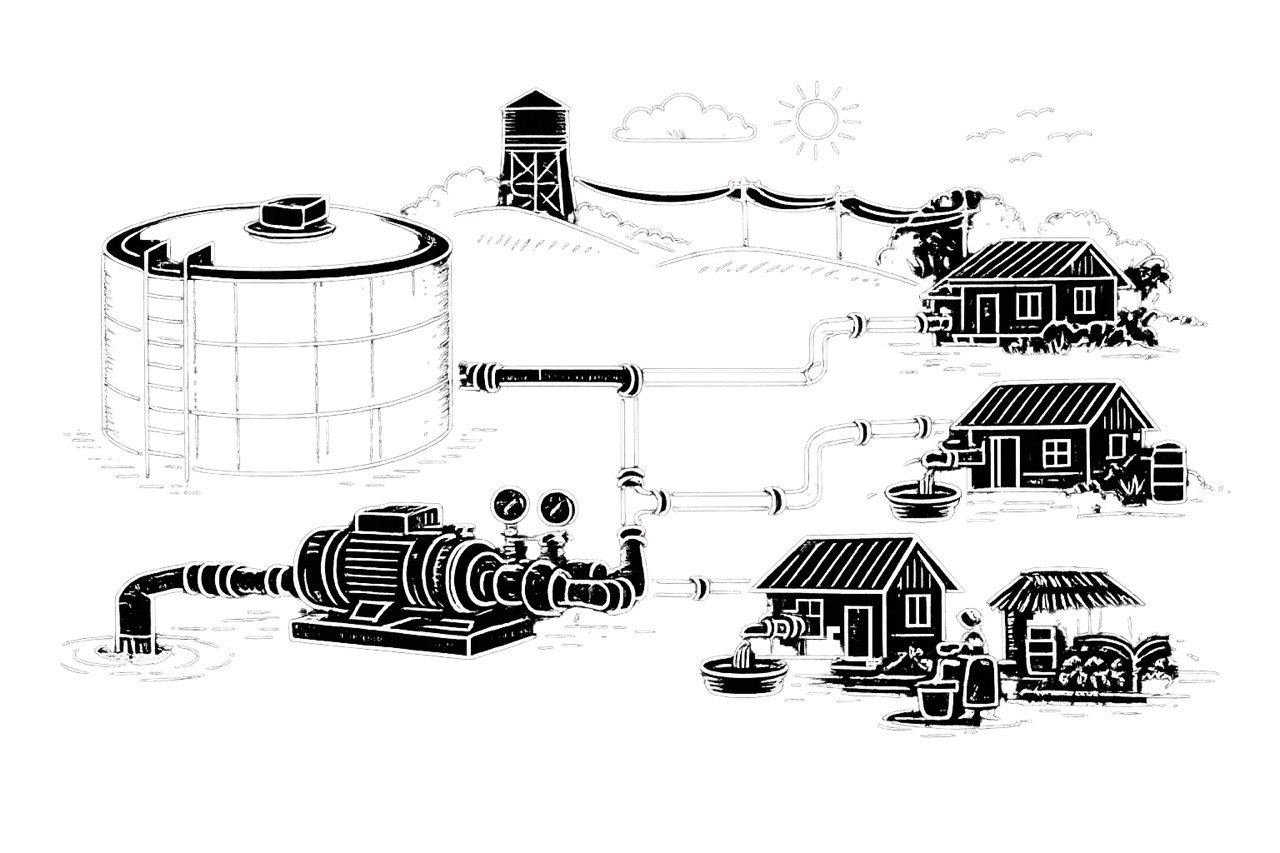
ASADA Santa Marta now operates a network of six registered wells with a combined capacity of over 10 liters per second. The system includes a 400-cubic-meter concrete storage tank at 95 meters elevation. All 406 active connections are metered.
100% metered service
Documented with MINAE
Concrete tank at 95m elevation
From all water sources
The water sources are registered with MINAE under authorization DA-1363-2021-AGUAS-MINAE, expediente 686-R. ASADA Santa Marta holds an official delegation agreement (convenio de delegación) with AyA.
What the Documents Show
This isn't a story that requires interpretation. The paper trail is clear:
Geologist José Vargas Gutiérrez documents contaminated wells and water crisis in Barrio Los Ángeles. Report requested by community water committee.
Perforaciones Jiménez y Delgado drills well GA-334. Invoice #148 for ₡5,424,000 paid by Nosara Constructions and Development Group. Well donated to ASADA Santa Marta.
Water sources registered with MINAE under DA-1363-2021-AGUAS-MINAE.
AyA formally publishes the ASADA Santa Marta water source registration in La Gaceta No. 201. Well P-6 GA-350 documented with flow rate of 1.24 L/s under expediente SGSC-2022-00088.
AyA approves technical study (Report GSD-UEN-GAR-2025-02417) for connecting Nosara Hills and Mar Azul via ASADA Santa Marta. System now serves 406 metered connections.
In Barrio Los Ángeles, children no longer drink from contaminated wells. Families no longer bathe in the river. The taps work.
Not because of a government program that arrived after decades of waiting. Because a community organized, a developer invested, and the infrastructure was built.
The documents are public record. The well is pumping. The water is clean.